
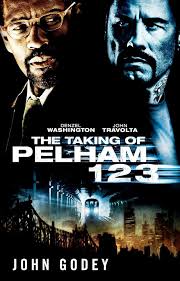
 The Taking of Pelham 123 is a fast-paced stylishly-directed thriller with riveting performances by Denzel Washington and John Travolta. It is also deeply unsatisfying. I felt the same way about Duplicity starring Julia Roberts and Clive Owen– great performances and a great disappointment. The endings of both movies left me shrugging and saying “Huh?” Both were box office duds. The lesson from both films is “earn your ending.”
In The Taking of Pelham 123 Denzel Washington plays Walter Garber, an ordinary man caught in the extraordinary circumstance of a subway hijacking. The film moves briskly along until the ending. Washington has absolutely no motivation and no compelling personal reason to go after the hijackers once he escapes the train. The car with the hostages exits the tunnel and races toward Coney Island. He can do nothing further there. He immediately alerts the cops to the hijackers’ whereabouts as they escape. The cops are already swarming the area. He no longer has any personal stake in their apprehension. He has a wife and family who depend on him. Earlier in the film, we learn is willing to do anything (even commit a crime) to provide for them. Suddenly, that is of no concern to him? After he hijacks an SUV, he gets to the remaining hijacker just as the cops are closing in. He has no purpose in the scene.
It’s incredibly easy to commit “suicide by cop.” All Travolta has to do is wave his gun around or fire at the on-rushing cops. That in fact, is what the other hijackers do and they are blown to bits. There is no reason for Travolta to fear jail time– the cops will gladly shoot him if threatened. The final discussion between Washington and Travolta is false, contrived and doesn’t ring true on any level.
The original film, released in 1974, starred Walter Mathau in the Walter Garber role. Mathau is a transit cop, also an ordinary man caught in the extraordinary circumstances of a subway hijacking. He uses dogged police work to capture the remaining hijacker (the only one who isn’t killed in the heist). Mathau is motivated, methodical and clever. He gets his man with skilled investigative work and his knowledge of the subway system. The original had a ending that was clever, satisfying and well-earned.
In Duplicity the ending comes out of no-where. In the last few minutes of the film, a larger conspiracy is revealed that was hidden from the mutually double-crossing-duo of Julia Roberts and Clive Owen. Neither one saw it coming and neither did the audience. All of the duo’s scheming, plotting, lying and effort is undone at last minute by invisible forces, leaving the audience wondering why we watched the two jump through meaningless hoops (to no apparent effect) during the film. A simple test applied by the insurance company quickly spotlights the ruse. None of the characters thought to ask this question over the course the movie’s 125 minute running time. This makes them look stupid and make the audience feel stupid for watching a plot that goes nowhere and sideswipes the us with a trick ending. It’s the same fury-inducing effect as the infamous shower “it was all a dream” season of the television series Dallas.
To learn how to write endings that feel authentic, earned and true check out The One Hour Screenwriter eBook. Learn everything you need to bring your story to a deeply satisfying conclusion.



No comment yet, add your voice below!