How to Evaluate Stories
April 6, 2012 – 11:56 AM | 2 Comments

This concise checklist of questions and examples helps writers, producers, editors, publishers, and development executives quickly zero in on key story problems. It reveals what’s missing in any problematic plot. Find what’s wrong and fix …

Share
Read the full story »
In the News

Film, television and web entertainment news from around the cool.

Movies

My film reviews and how the Nine Character Types affects the success or failure of the script.

Television

What’s on TV? How the right Character Types help make a hit or miss.

Writing Tips

Making the writing life work for you. Tips and tricks to keep your writing fresh and interesting.

Musings

Random thoughts on pop culture and the world at large.

Home » Musings, Writing Tips

Is “Good Writing” A Matter Of Culture?

Submitted by on January 22, 2010 – 6:47 PMNo Comment
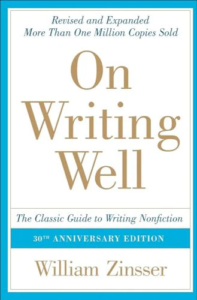
By William Zinsser
A talk to the incoming international students at the Columbia Graduate School of Journalism, August 11, 2009
Five years ago one of your deans at the journalism school, Elizabeth Fishman, asked me if I would be interested in tutoring international students who might need some extra help with their writing. She knew I had done a lot of traveling in Asia and Africa and other parts of the world where many of you come from.
I knew I would enjoy that, and I have—I’ve been doing it ever since. I’m the doctor that students get sent to see if they have a writing problem that their professor thinks I can fix. As a bonus, I’ve made many friends—from Uganda, Uzbekhistan, India, Ethiopia, Thailand, Iraq, Nigeria, Poland, China, Colombia and many other countries. Several young Asian women, when they went back home, sent me invitations to their weddings. I never made it to Bhutan or Korea, but I did see the wedding pictures. Such beautiful brides!
I can’t imagine how hard it must be to learn to write comfortably in a second—or third or fourth—language. I don’t think I could do it, and I admire your grace in taking on that difficult task. Much of the anxiety that I see in foreign students could be avoided if certain principles of writing good English—which nobody ever told them—were explained in advance. So I asked if I could talk to all of you during orientation week and tell you some of the things my students have found helpful.
So that’s why we’re here today.
I’ll start with a question: What is good writing?
It depends on what country you’re from. We all know what’s considered “good writing” in our own country. We grow up immersed in the cadences and sentence structure of the language we were born into, so we think, “That’s probably what every country considers good writing; they just use different words.” If only! I once asked a student from Cairo, “What kind of language is Arabic?” I was trying to put myself into her mental process of switching from Arabic to English. She said, “It’s all adjectives.”
Well, of course it’s not all adjectives, but I knew what she meant: it’s decorative, it’s ornate, it’s intentionally pleasing. Another Egyptian student, when I asked him about Arabic, said, “It’s all proverbs. We talk in proverbs. People say things like ‘What you are seeking is also seeking you.’” He also told me that Arabic is full of courtesy and deference, some of which is rooted in fear of the government. “You never know who’s listening,” he said, so it doesn’t hurt to be polite. That’s when I realized that when foreign students come to me with a linguistic problem it may also be a cultural or a political problem.
Now I think it’s lovely that such a decorative language as Arabic exists. I wish I could walk around New York and hear people talking in proverbs. But all those adjectives and all that decoration would be the ruin of any journalist trying to write good English. No proverbs, please.
Spanish also comes with a heavy load of beautiful baggage that will smother any journalist writing in English. The Spanish language is a national treasure, justly prized by Spanish-speaking people. But what makes it a national treasure is its long sentences and melodious long nouns that express a general idea. Those nouns are rich in feeling, but they have no action in them—no people doing something we can picture. My Spanish-speaking students must be given the bad news that those long sentences will have to be cruelly chopped up into short sentences with short nouns and short active verbs that drive the story forward. What’s considered “good writing” in Spanish is not “good writing” in English.

feda2William Zinsser discusses how “good writing” is a matter of cultural difference.  Here’s what he said in a talk to the incoming international students at the Columbia Graduate School of Journalism on August 11, 2009:

Five years ago one of your deans at the journalism school, Elizabeth Fishman, asked me if I would be interested in tutoring international students who might need some extra help with their writing. She knew I had done a lot of traveling in Asia and Africa and other parts of the world where many of you come from.

I knew I would enjoy that, and I have—I’ve been doing it ever since. I’m the doctor that students get sent to see if they have a writing problem that their professor thinks I can fix. As a bonus, I’ve made many friends—from Uganda, Uzbekhistan, India, Ethiopia, Thailand, Iraq, Nigeria, Poland, China, Colombia and many other countries. Several young Asian women, when they went back home, sent me invitations to their weddings. I never made it to Bhutan or Korea, but I did see the wedding pictures. Such beautiful brides!

I can’t imagine how hard it must be to learn to write comfortably in a second—or third or fourth—language. I don’t think I could do it, and I admire your grace in taking on that difficult task. Much of the anxiety that I see in foreign students could be avoided if certain principles of writing good English—which nobody ever told them—were explained in advance. So I asked if I could talk to all of you during orientation week and tell you some of the things my students have found helpful.

So that’s why we’re here today.

I’ll start with a question: What is good writing?

It depends on what country you’re from. We all know what’s considered “good writing” in our own country. We grow up immersed in the cadences and sentence structure of the language we were born into, so we think, “That’s probably what every country considers good writing; they just use different words.” If only! I once asked a student from Cairo, “What kind of language is Arabic?” I was trying to put myself into her mental process of switching from Arabic to English. She said, “It’s all adjectives.”

Well, of course it’s not all adjectives, but I knew what she meant: it’s decorative, it’s ornate, it’s intentionally pleasing. Another Egyptian student, when I asked him about Arabic, said, “It’s all proverbs. We talk in proverbs. People say things like ‘What you are seeking is also seeking you.’” He also told me that Arabic is full of courtesy and deference, some of which is rooted in fear of the government. “You never know who’s listening,” he said, so it doesn’t hurt to be polite. That’s when I realized that when foreign students come to me with a linguistic problem it may also be a cultural or a political problem.

Now I think it’s lovely that such a decorative language as Arabic exists. I wish I could walk around New York and hear people talking in proverbs. But all those adjectives and all that decoration would be the ruin of any journalist trying to write good English. No proverbs, please.

Spanish also comes with a heavy load of beautiful baggage that will smother any journalist writing in English. The Spanish language is a national treasure, justly prized by Spanish-speaking people. But what makes it a national treasure is its long sentences and melodious long nouns that express a general idea. Those nouns are rich in feeling, but they have no action in them—no people doing something we can picture. My Spanish-speaking students must be given the bad news that those long sentences will have to be cruelly chopped up into short sentences with short nouns and short active verbs that drive the story forward. What’s considered “good writing” in Spanish is not “good writing” in English.

Read the rest of the speech here at theamericanscholar.org
Share

Leave a comment!

Add your comment below, or trackback from your own site. You can also subscribe to these comments via RSS.

Be nice. Keep it clean. Stay on topic. No spam.

You can use these tags:
<a href="" title=""> <abbr title=""> <acronym title=""> <b> <blockquote cite=""> <cite> <code> <del datetime=""> <em> <i> <q cite=""> <strike> <strong>

This is a Gravatar-enabled weblog. To get your own globally-recognized-avatar, please register at Gravatar.